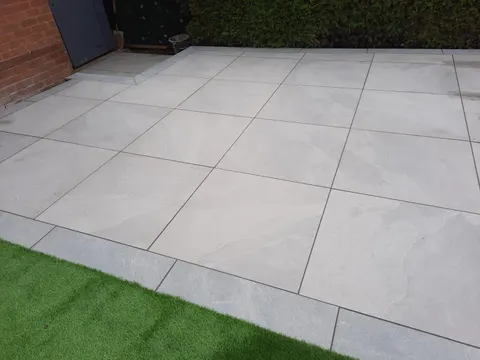


We're often asked to look at patios that are only a few years old and already failing. Slabs rock underfoot, water sits in puddles, weeds push up through the joints, or a wall inside the house has started to show damp. The stone is rarely the problem. Almost every failure comes back to how the patio was laid. These are the mistakes we see most often in Leeds, and what a properly laid patio does instead.
1. Not enough sub-base
The part of a patio you never see does most of the work. Slabs laid straight onto soil, or onto a thin layer of loose hardcore, will sink as the ground moves and settles, and Leeds clay moves a lot between wet winters and dry summers. We dig out to around 15cm and lay a compacted hardcore sub-base before any mortar goes down, so the patio sits on something that won't shift.
2. Dot-and-dab bedding
Laying slabs on five dabs of mortar, one in each corner and one in the middle, is quick and uses less material. It also leaves hollow spaces under every slab. Those slabs rock, crack when something heavy is put on them, and let water collect underneath, which can show through as dark patches on natural stone. A full mortar bed supports the whole slab and helps keep weeds out from below.
3. No fall, or a fall the wrong way
A patio should never be perfectly flat. It needs a slight, even slope so rainwater runs off to the garden or a drain instead of sitting on the surface. Get it wrong and you have puddles, slippery green patches and, worst of all, water running towards the house. Every patio we lay is set with a fall away from the building.
4. Built too high against the house
A patio against the house should finish at least 150mm below the damp-proof course. Paving laid higher than that, often because new slabs went straight over an old surface, lets rain splash above the damp course and can bridge it, which is one of the most common causes of damp on a ground-floor wall. If there isn't enough height to play with, the ground needs digging out or a drainage channel needs adding.
5. Porcelain laid like natural stone
Porcelain paving is dense and barely absorbs water, so mortar doesn't grip it the way it grips sandstone or Indian stone. Each porcelain slab needs a priming slurry on the back before it goes down. Skip that step and the slabs can lift away from the bed, sometimes within the first winter. Porcelain also needs cutting with the right blade so the edges don't chip.
6. Weak or rushed jointing
Brushing dry sand or a weak, dry mix into the joints looks tidy on the day, but it washes out, lets weeds in and loosens the edges of the slabs. Pointing too soon, before the bed has set, or just before heavy rain causes the same problems and can stain the stone. We let the mortar bed set for about 24 hours before the joints are pointed, using a method suited to the stone.
7. Ignoring the slope and the edges
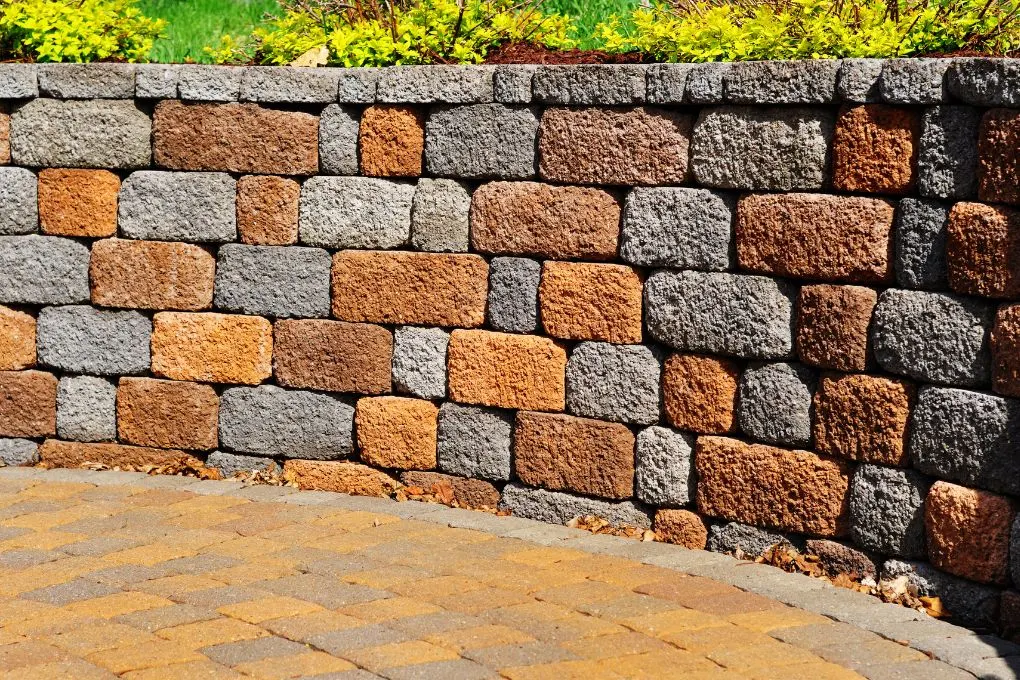
On a sloping garden, the patio is only as good as what holds the ground around it. Soil heaped behind a patio with nothing to retain it will slump onto the paving, and a low wall built without proper foundations will lean. Where levels change we build retaining walls and steps on proper footings, and finish the edges so the slabs at the outside can't creep or drop.
Can a failing patio be saved?
Sometimes. A few loose slabs on a sound base can be lifted and relaid, and tired joints can be raked out and re-pointed. If the base itself has failed, or the patio is too high against the house, it's usually cheaper in the long run to take it up and start again than to keep patching it. We'll tell you honestly which applies when we see it.
Getting it right first time
A well-laid patio should last decades with little more than a clean now and then. If you're planning a new one or want an old one checked, see our patios in Leeds page and our paving costs guide, or call 0113 519 1919 to arrange a free survey. You can also send us photos for an estimated price.